Validate a Product Idea From Real Audience Questions
Validate a product idea from real audience questions on X, Reddit and our own lists, using a rule set first, and why the verdict was not yet.
"Validate before you build" is good advice that usually skips the hard part: deciding in advance what counts as validation. Without a rule, you search until you find enough posts that agree with you.
So we wrote the rule first, then ran it for real on WorkCue's next product. The result wasn't the one we'd have liked, and that's the point of this guide.
Step 1: Write the decision rule before you search
Ours, written on October 10 before any query ran:
Pick an idea only if it has at least 10 logged questions from at least 2 sources, and it leads in at least one of our own data sources (site analytics, email list interest, signups). Otherwise the verdict is "not enough evidence; next check on a set date."
We also fixed the details that make cherry-picking easy:
- The queries. Five on X, five on the web, listed below, run exactly as written.
- The window. The last 30 days only. Old threads show a problem existed once, not that people have it now.
- What counts. A real person asking how to do something. Vendors, ads and our own posts don't count.
- A cap. Read up to 30 results per query and log up to 15.
Step 2: Search public questions with fixed queries
On X (post search, English, no reposts, from September 10, 2026):
| Query | Results | Real questions |
|---|---|---|
freelance "scope creep" | 24 | 0 |
"change order" freelance | 8 | 0 |
"how do I" proposal freelance | 6 | 0 |
"first course" OR "sell a course" "how do I" | 4 | 0 |
"digital product" "how do I" beginner | 1 | 0 |
Zero questions from 63 posts surprised us. One result did look like a question: "How do freelance developers prevent client scope creep and lock project requirements before coding?" (X, September 25, 2026). But it repeats itself and ends in a promo link, so under our rule it's not a real person asking. We logged it as excluded, so the decision is visible.
What X did show was supply. About 12 of the 32 proposal-topic posts were people selling scope-creep tools and templates, some with public prices: a pack of client email templates "$29 once" (October 5) and a "$19 PDF" on proposals and scope creep (October 5). That suggests people pay for answers on topic A, but it isn't a question, so it doesn't count toward the rule. The course queries returned mostly income-hype posts.
On Reddit and Indie Hackers (web search with the fixed site: queries), we found real questions, then checked each post's exact date:
| Thread | Topic | Posted (UTC) | In window? |
|---|---|---|---|
| "Lost $2,300 to scope creep on one project. How do you prevent this?" (r/freelance) | A | November 17, 2025 | No |
| Course-structure planning question (r/onlinecourses) | B | May 6, 2026 | No (since removed by a moderator) |
| "Stuck on creating course" (r/onlinecourses) | B | April 17, 2026 | No (since removed by a moderator) |
| "How do you handle clients who ask for things outside the original scope?" (r/Freelancers) | A | June 12, 2026 | No |
| "How do you handle extra work when a client changes the scope?" (r/freelancing) | A | July 23, 2026 | No |
| "How do you actually handle a client who keeps asking for 'one more small change'?" (r/Freelancers) | A | August 22, 2026 | No |
The last three came from two extra searches outside our fixed list, so they wouldn't have counted anyway. The Indie Hackers query returned only launch success stories from 2020 to 2022, no questions.
Search results don't show dates reliably. Four of these six looked current in the results. Only opening each thread and reading its timestamp showed that none fell inside the window.
Step 3: Check your own data, and check that it's complete
Email lists. Kit had 0 real subscribers at 1:58 PM PT on October 10 (our labelled test addresses excluded). Every contact in Systeme.io was a labelled test. The newsletter form's interest checkboxes (proposals or courses) had been live for about an hour. There's nothing to compare yet.
Site analytics. This is where we found a real problem. The first Cloudflare Web Analytics entry we opened for useworkcue.com showed only 40 visits in 30 days, all between September 27 and 29.
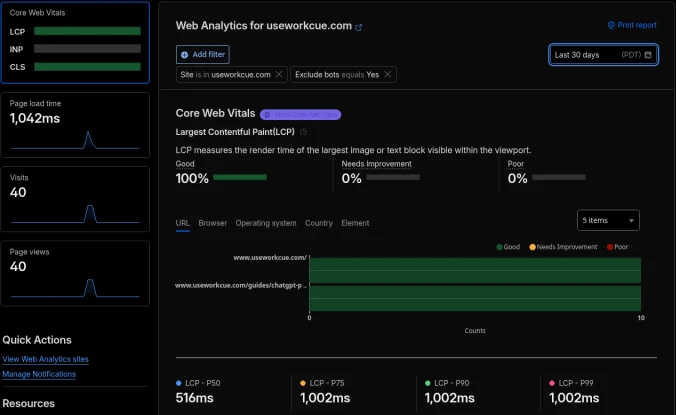
A site that's been publishing guides every weekday doesn't drop to zero, so we checked which entry the live site was actually reporting to. The tracking snippet on every page carries a token. We read the token from the live page source and matched it against the Web Analytics entries. It belonged to a second useworkcue.com entry, created around September 29, when the snippet was replaced. The old entry kept the first three days; the new one had everything since.
The check, if you use Cloudflare Web Analytics: view your page source, find the token in the data-cf-beacon attribute of the cloudflareinsights.com/beacon.min.js script, and confirm it matches the site entry you're reading. If you've ever re-added a site, you may have two entries with the same name.
The live entry's numbers, with bots excluded:
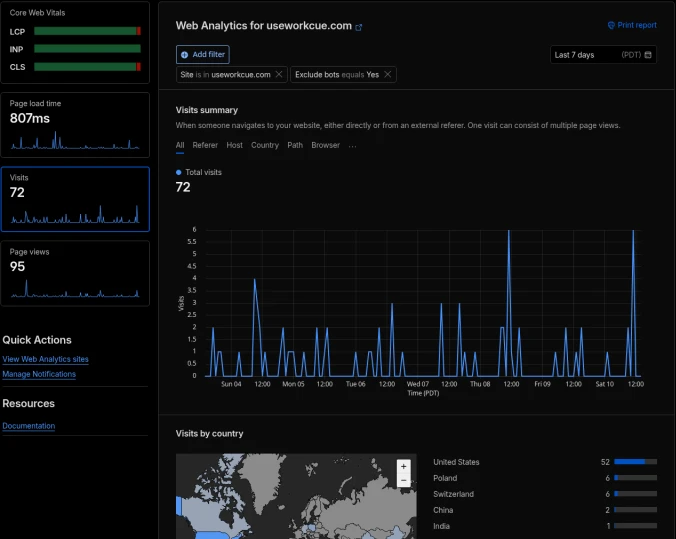
- Last 7 days: 72 visits, 95 page views. Referrers: direct 64, Google 8. Top paths by visits: home page 37, our cold-email prompts guide 7, our Claude for client work guide 7, our lead-intake-to-proposal guide 4, contact page 4. No visits to the product page or free checklist appeared in the list.
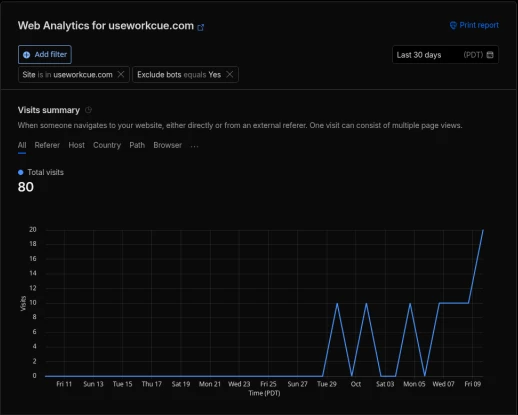
- Last 30 days: 80 visits, 130 page views. The 30-day view rounds to tens and only has data from about September 29, so the 7-day figures are the precise ones.
Mapped to our two ideas: one top page is about proposals (4 visits), none is about courses. That's a lead for A in one source, but 4 visits is too small to mean much.
Step 4: Apply the rule
| A: proposals | B: courses | |
|---|---|---|
| Real questions in the window | 0 | 0 |
| Sources with questions | 0 | 0 |
| Kit interest (real) | 0 | 0 |
| Top-page visits, last 7 days | 4 | 0 |
| People already paying for answers (public prices) | Yes: $19 and $29 examples | Not found in this run |
The first condition, 10 questions from 2 sources, fails for both ideas. So the verdict is set by the rule, not by us:
Not enough evidence yet. Leaning proposals. Next check: November 9, 2026.
"Leaning" is a note, not a decision. Topic A questions keep appearing on Reddit across 2025 and 2026, A had the only relevant top page, and people visibly sell answers to it. None of that met the bar, and we're not going to move the bar after the fact.
What we'll do before the next check
- Keep the queries and the rule exactly as they are, so November's numbers are comparable.
- Read each Reddit thread's timestamp in the browser, not the search result date.
- Leave the newsletter's interest checkboxes running for a month, and count real ticks only.
- Re-check the analytics token whenever the site's tracking snippet changes.
If you're stuck between ideas too, the mini-course outline guide shows what we'd do with a topic once it passes, and our Kit tags and segments guide shows how the interest checkboxes are set up on Kit's free plan.
Your checklist
- Write the decision rule, window and queries before searching
- Count only real people asking, inside the window
- Open every thread and read its real date
- Log what you excluded and why
- Check that your analytics token matches the entry you're reading
- Put small numbers next to each other without rounding up
- Accept "not enough evidence" and set the next check date
Related guides
Outline a mini-course with AI, then cut it to 5 lessons
An AI course outline cut from 12 lessons to 5: the exact prompts, raw outputs, scoring against one outcome, and the fact-check fixes we made by hand.
Scope Creep With AI: Change Request Replies and Orders
Handle scope creep with AI: check client requests against agreed scope, draft a calm reply and a one-page change order, with human gates on price.
Kit Tags and Segments on the Free Plan (Tag From a Form)
Kit tags and segments on the free plan: no auto-tag rule, so we tagged from the form itself, built five segments and excluded test subscribers.