Outline a mini-course with AI, then cut it to 5 lessons
An AI course outline cut from 12 lessons to 5: the exact prompts, raw outputs, scoring against one outcome, and the fact-check fixes we made by hand.
A free mini-course works best when it's short and does one job. AI is good at the opposite: ask it for a course outline and it gives you everything it can think of. So we used it that way on purpose. We asked for a wide outline, then scored and cut it against one outcome, and checked every line of the lesson briefs against our own material.
This guide is the record of that run, with the exact prompts, the raw outputs and every hand correction.
Why outline wide, then cut
If you ask for "a 5-lesson course", the model picks the 5 lessons for you, and you never see what it left out or why. Asking for 12 and cutting to 5 yourself turns the outline into a list of decisions you can check. Every dropped lesson has a reason you wrote down.
The cut only works if you decide the rules before you see the outline. Otherwise you end up keeping whatever sounds good.
Our first course didn't use this process
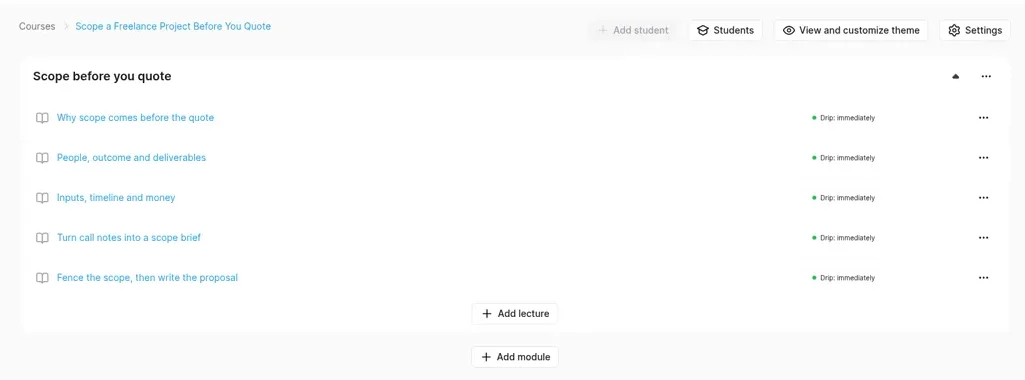
Our first free course, "Scope a Freelance Project Before You Quote", wasn't outlined with AI. We wrote its 5 lessons directly from material we already had: the scope checklist and one prompt from our proposal kit. It runs on Systeme.io's free plan; see how we built it.
What it gave us is a known-good shape: 5 lessons of 414, 470, 449, 513 and 587 words (2,433 in total), one exercise each, about 10 to 15 minutes of reading. We used that as the target for course #2, because we know that shape can be built and delivered on a free plan.
Step 1: Write the brief before any AI step
The brief is the part people skip, and it's the part that makes the cut honest. Ours, written before the first prompt:
- Topic: handle scope creep without losing the client. We chose it because our own guide and kit already cover it, so every lesson can have a real source. We haven't validated demand for it yet.
- Outcome (one sentence): by the end, you can reply to an out-of-scope request calmly and send a one-page change order the client approves in writing.
- Constraints: free, text-only, 5 lessons, 10 to 15 minutes of reading, one exercise each, no income claims, no legal advice.
- Allowed sources: our guide on scope creep with AI, kit prompts P16 (scope-creep reply) and P17 (change order), and five items from our free scope checklist.
- Cut rules: keep only what the outcome needs; merge lessons that share one exercise; drop anything that needs legal advice, data we don't have, or an invented example; drop what course #1 already teaches; each lesson must fit one sitting.
Step 2: Ask for the wide outline, and don't edit it
The prompt, word for word:
Outline a free text-only mini-course for freelancers called "Handle scope creep without losing the client". Give 12 lessons in a sensible order. For each: a title and a one-line goal. Audience: freelancers and solo consultants who sell scoped projects. Don't cut anything yet; I'll cut later.
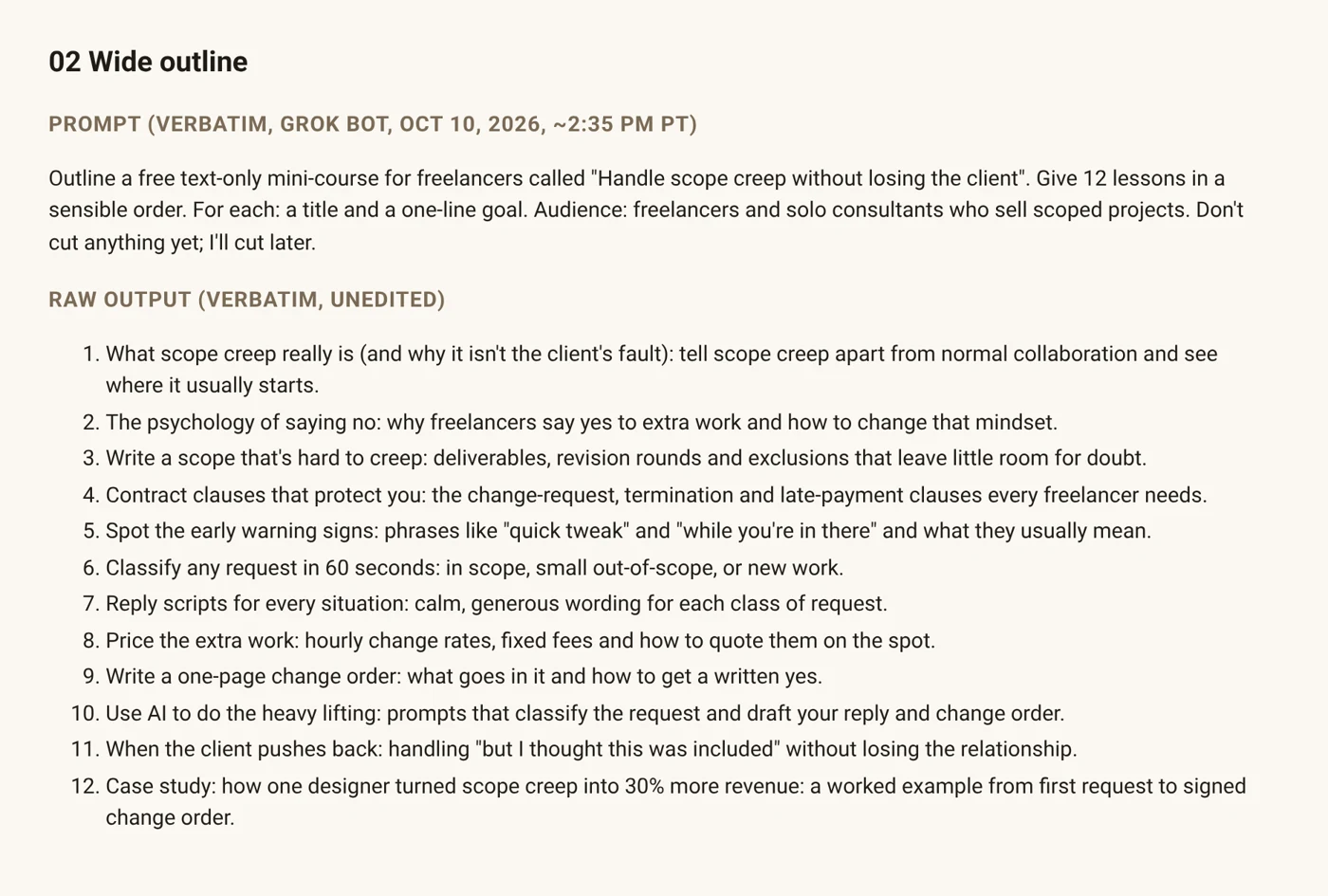
Two lessons stand out straight away. Lesson 4 promises "the clauses every freelancer needs", which is legal advice. Lesson 12 is a case study titled "how one designer turned scope creep into 30% more revenue". There's no designer and no 30%. The model invented a result to make the title appealing. That's normal for a first outline, and it's why you save it unedited: the guide shows what the tool actually does.
Step 3: Score every lesson against the outcome
We asked the model to score each lesson on four things: is it needed for the outcome, does course #1 already cover it, does it need material we don't have, and does it fit one sitting. Then we checked every score by hand.
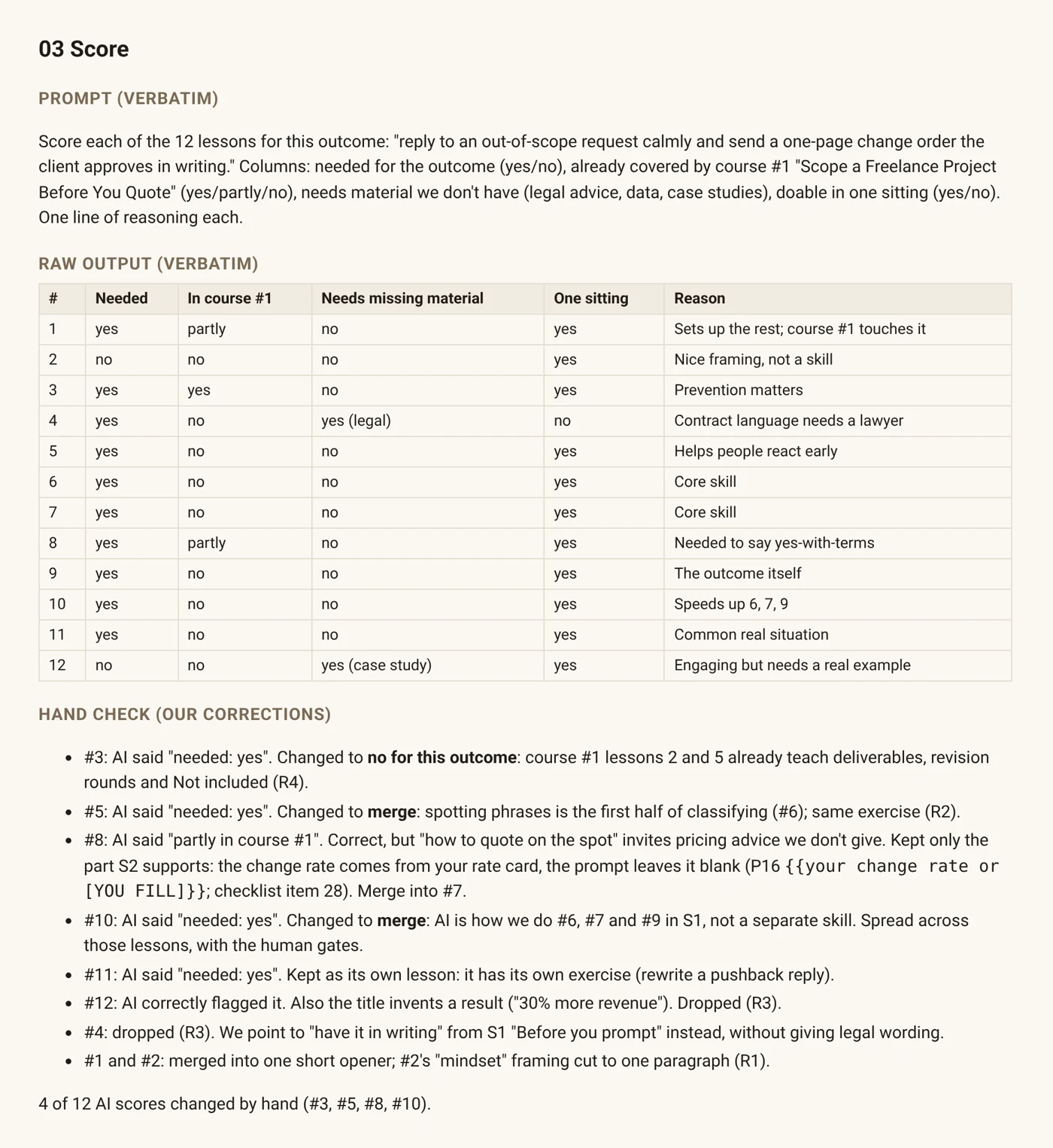
The model marked 10 of 12 lessons as "needed". That's the main weakness of asking AI to score its own outline: almost everything looks necessary. Our changes:
- "Write a scope that's hard to creep": the model said needed. Course #1 already teaches deliverables, revision rounds and a Not included list, so we link it instead.
- "Spot the early warning signs": spotting phrases like "quick tweak" is the first half of classifying a request. Same exercise, so it merged.
- "Price the extra work": we kept only what our sources support: your change rate comes from your own rate card, and the prompt leaves it blank. No advice on what to charge.
- "Use AI to do the heavy lifting": AI is how you do the other lessons, not a separate skill. We spread it across them, each with its human check.
The model did get two things right without help: it flagged the contract lesson as needing legal advice and the case study as needing a real example.
Step 4: Cut to 5 and record where everything went
With the corrected scores and the rules from the brief, the cut was mostly mechanical. The important part is the "moved" list: nothing disappears without a note.
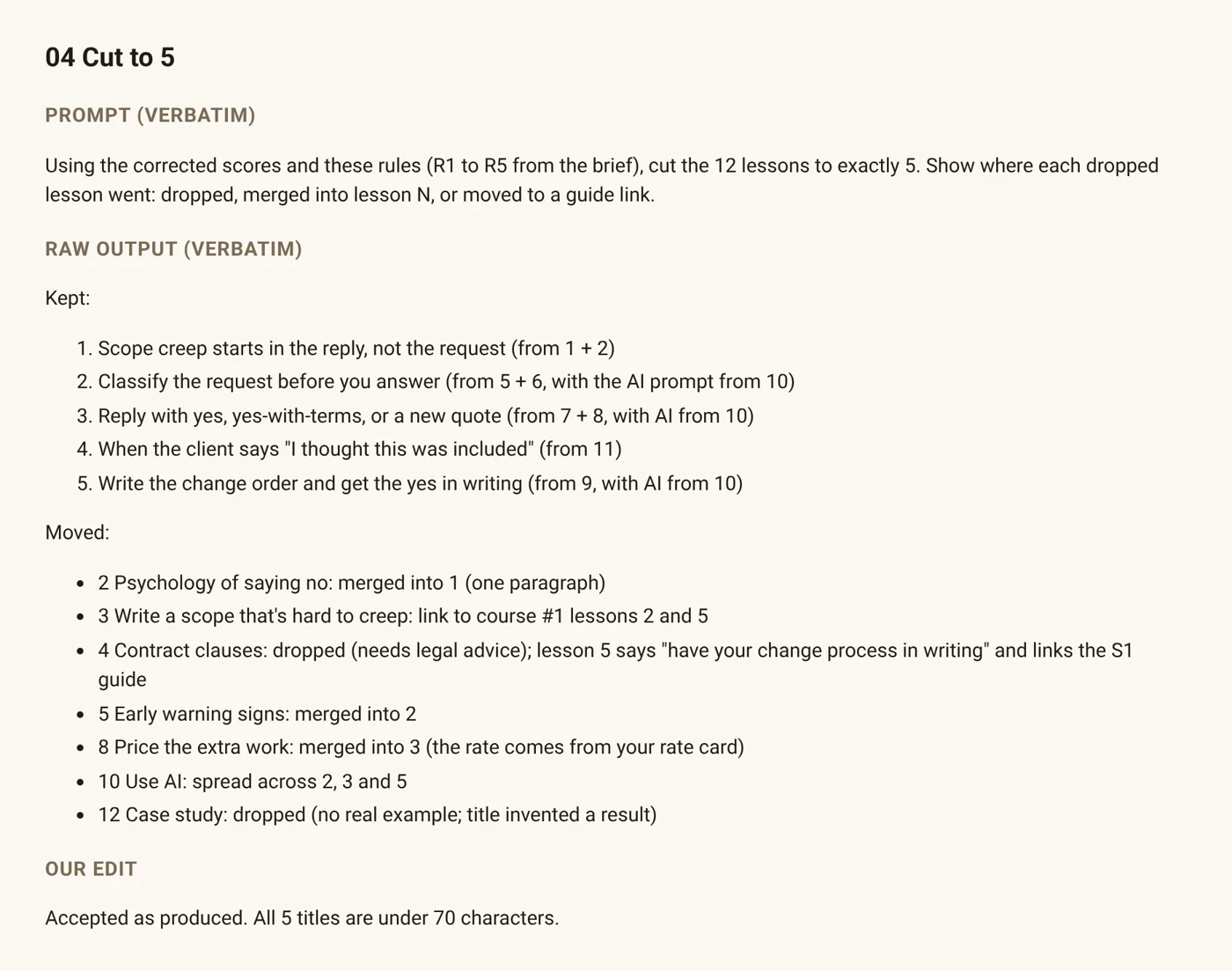
The final 5:
- Scope creep starts in the reply, not the request
- Classify the request before you answer
- Reply with yes, yes-with-terms, or a new quote
- When the client says "I thought this was included"
- Write the change order and get the yes in writing
Lesson 4 is the AI's best contribution. Our own guide only touches pushback in one FAQ answer. The model noticed it's a common real situation with its own exercise, and the scoring backed that up.
Step 5: Write lesson briefs, then check every line
For each lesson we asked for a title, a goal, 3 to 5 key points with a source for each, one exercise and a word target. We told it to use only the allowed sources and add no statistics. Then we opened every source and checked every point.
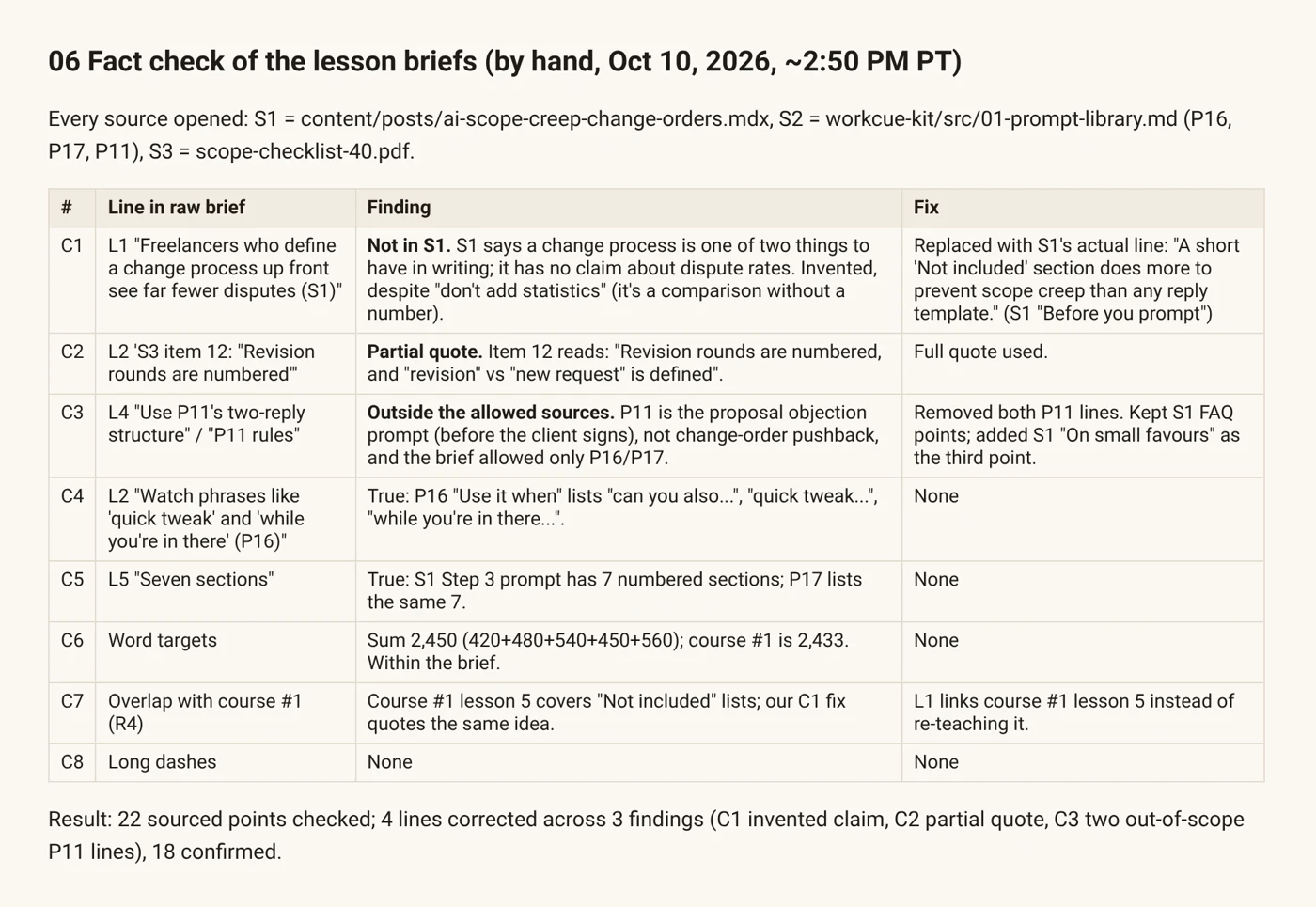
What we found:
- An invented claim with a real-looking source. Lesson 1 said "freelancers who define a change process up front see far fewer disputes" and cited our guide. Our guide says no such thing. There's no number in it, so it slipped past "no statistics", but it's still a claim we can't back. We replaced it with a line the guide really says.
- A partial quote. A checklist item was cut short, which changed its meaning. The full item says revision rounds are numbered and "revision" vs "new request" is defined. We used the full wording.
- A source outside the brief. Lesson 4 borrowed two lines from our proposal objection prompt, which is for before the client signs, not for change-order pushback. We removed both and kept the guide's own advice: go back to the agreed scope, offer a later phase or adjust what's included.
The other 18 points matched their sources. The word targets added up to 2,450, close to course #1's 2,433.
Course #1 against course #2
| Course #1 | Course #2 (outline only) | |
|---|---|---|
| How it was outlined | Written from existing material, no AI outline | AI wide outline of 12, scored, cut to 5 |
| Lessons and exercises | 5, one exercise each | 5, one exercise each |
| Words | 2,433 written | 2,450 target, not written yet |
| Hand corrections | Not tracked | 4 scores, 4 brief lines |
| Status | Live on Systeme.io Free | Briefs only, not built |
The AI saved time on the wide view and spotted a lesson we'd have missed. It also invented a result, scored almost everything as necessary, and slipped in one unsupported claim. All of that was caught because the brief and cut rules existed before the outline did.
Where you could build it on a free plan
Systeme.io's free plan includes one course, and ours is in use. So building course #2 there would mean replacing course #1 or upgrading. Other options are a short email course (the lessons sent as a sequence) or a second platform's free plan. We haven't decided, and we're not promising a launch date.
Your checklist
- Write the outcome in one sentence before any prompt
- Set the cut rules and allowed sources before you see the outline
- Ask for 10 to 12 lessons and save the output unedited
- Check every "needed" score: AI marks almost everything as needed
- Drop invented examples and anything needing legal advice
- Record where every dropped lesson went
- Open every cited source and check quotes word for word
- Keep the shape small enough to finish: 5 lessons, one exercise each
Related guides
Systeme.io Free Course With Auto-Enrolment: A Real Build
A free 5-lesson course on Systeme.io's Free plan with an opt-in page that auto-enrols and tags people: every screen, plan limits and gotchas.
Scope Creep With AI: Change Request Replies and Orders
Handle scope creep with AI: check client requests against agreed scope, draft a calm reply and a one-page change order, with human gates on price.
Fact-Check an AI Sales Page Against Your Product
Fact-check an AI sales page: we checked every claim on our $9 kit's page against the real files, with the claim table and what we had to cut.